The outings

The Gibraltar Ornithological & Natural History Society organise monthly outings for it's members within Gibraltar and further afield into Andalucía, visiting a variety of locations covering diverse habitats and offering the opportunity to see the wildlife of this beautiful area. The venues for the outings are chosen and timed to coincide with the season's happenings: see Cranes in their wintering grounds, Orchids in the spring, wading birds in the Doñana wetlands, butterflies and Ibex in the Sierras, come Autumn mushrooming in the Alcornocales and enjoy the spectacular sights of thousands of migrating raptors right on your doorstep.

For dates, contacts and how to join us, see the gonhs website

Thursday, September 22, 2011

Bat night report and extra batty bits

I am sorry to have missed last Saturday's 'Bat night', but the report posted out to members was so descriptive I could almost picture the event. For any non-members that click on to this post, here is a copy of the report:


18 September 2011
5th EUROPEAN BAT NIGHT SUCCESS

The Eurobats 'European Bat Night' held at the Open Air Theatre at the Alameda Botanic Gardens was attended by over fifty participants and quite a few bats as well.

At around 8.30pm most participants were sat down in the auditorium where some were able to see a migrating Osprey fly over Gibraltar on its way to Africa. A visiting European Kingfisher also arrived onto the stage where it selected a branch on which it settled down to roost for the night.

For the fist time in our local event, participants were able to hear a selection of recorded bat calls prior to the real bats making their appearance. It was therefore appropriate that the last recorded call played was that of a pipistrelle bat, as moments later, the first of several feeding Soprano pipistrelle bats Pipistrellus pygmaeus fluttered over the pond hawking after insects.

This was the first of several visits by this species during the course of the evening. During short periods of bat inactivity, Albert Yome, Bat Group coordinator for GONHS took a number of bat related questions, in which he took great delight in being able to answer. "How do you tell male and female bats apart?" was one little boy's memorable question. Albert's answer was, "The same way as you would cats or dogs."

Later the first of several one a larger, faster bats swooped in from over the trees. For what seemed like greater effect, these and some of the pipistrelles flew in form directly behind their audience, taking them by surprise.

This year, the bat detector was linked to the theatre's own sound desk, giving participants 'surround sound'. The theatre's lights were also in operation, being balanced to provide enough lights for foraging bats to be seen yet not so bright so as to deter them from visiting. A  big thanks here to Danny Montovio and Mark Cortes for the sound and lights respectively.

We would like to go out to search for Gibraltar's largest bat species, the powerful European Free-tailed bat Tadarida teniotis one evening, so please email bats@gonhs.org to register your interest soon.


Interesting links to websites for photographs and/or further information about the bat species mentioned in the report:

Amazing images of Pipistrellus pygmaeus:  http://www.naturephoto-cz.eu/pipistrellus-pygmaeus-picture-14093.html

Images and information about Pipistrelle bat species: http://www.arkive.org/pipistrelle-bats/pipistrellus-pipistrellus-and-pipistrellus-pygmaeus/image-A4407.html

Images and information about European Free-tailed bat also on the above site : http://www.arkive.org/european-free-tailed-bat/tadarida-teniotis/


I also came across this article (and advertisement for a book) on the Oxford University Press (OUP) that I have copied here:


By John D. Altringham


2011-12 is the International Year of the Bat sponsored by the United Nations Environment Programme. Yes, that’s right – we are devoting a whole year to these neglected and largely misunderstood creatures. Perhaps if I give you a few bat facts and figures you might begin to see why.
There are approaching 5,700 species of mammal in the world – wallabies to whales, manatees to marmosets, tigers to tenrecs. A hugely diverse group, yet one in every five of them is a bat – that’s over 1,100 species. There are, admittedly, even more mice and rats, but to my (wholly objective and unbiased) mind, when you’ve seen one rat there are few surprises left among the rest. Bats, however, are wonderfully diverse. And they are just about everywhere – except the Antarctic.
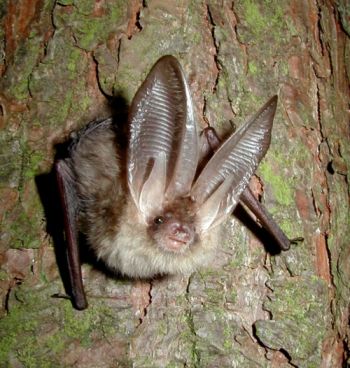
Over 60 million years of evolution (early bats witnessed the demise of the dinosaurs) and the ability to fly and navigate in the dark, have given bats the means to occupy a huge range of ecological niches. Think of something edible and there is probably a bat that eats it: fish, fowl and amphibians, other mammals, a whole range of invertebrates including scorpions and crabs, fruit, nectar, pollen, leaves, nuts, and of course that most nutritious of substances that has given bats such a bad name – blood. In defence of bats as a group, I point out that only three species drink blood.
Because they fly, bats have an unusual life history strategy. For reasons I will not go into (read my book – it’s not what you think) the vast majority of bats give birth to only one baby and typically only once a year. Bats therefore have to live for a long time – much longer than they ought to for their size – if they are to keep their numbers up. A five gram shrew puts a prodigious effort into eating and sex for 12 months (if it is lucky) before dropping dead, presumably of exhaustion. A five gram bat may live for 10-25 years or more. The last time I looked, the record was a five gram whiskered bat that has returned to the same hibernation site each year for at least 43 years!
Lifespan is not the only way in which bats think big. Bats form the largest aggregations of mammals on the planet, with some caves being home to several million bats. At the other end of the scale there are small family units and even solitary bats. Most are highly social animals that use the landscape on an impressive scale. Stable social structures involving surprising levels of communication and cooperation are common. These complex societies persist despite frequent roost switching, the need to forage over large areas and in many species the necessity of long seasonal migrations.
Bats are important in a wider conservation context. We have known for a long time that fruit bats in both the Old and New World tropics are important pollinators and seed dispersers – we are only just beginning to document the crucial role they play in tropical forest regeneration and maintenance. They are economically important pollinators of a wide range of fruits in the Old World tropics and their contribution to the US economy as controllers of insect pests was recently valued at $23 billion dollars per year, perhaps as much as $50 billion. Bats have most of the attributes needed of a good biodiversity indicator group – widespread, ecologically diverse, lots of species, high in food webs, ecosystem service providers, etc. Monitor the health of our bat populations and we get a good insight into the health of the environment in which they (and we) live.
And if that’s not enough, they have ‘engineering’ skills to astound and inspire us. It was recently discovered that echolocating bats make use of ‘parallel navigation’ to track and catch their insects – a technique only recently mastered in the most sophisticated guided missiles. I could go on…
So, why have bats had such a bad press until recently? I think Bram Stoker has a lot to answer for. In European traditions, pre-Stoker, vampires took many forms – but very rarely that of a bat. In cultures across the world bats (with a few exceptions) traditionally had and have a positive image. In China the symbol of good luck, the Wu Fu is a peach tree surrounded by five bats, representing health, tranquillity, wealth, good fortune and a long life. May you be blessed with all five and an informed appreciation of bats.
John Altringham is Professor of Animal Ecology and Conservation at the University of Leeds, UK, where he has been since 1989. He completed his BSc at the University of York, and his PhD at St. Andrews University, where he returned as a research fellow from 1983-1989. During his career he has travelled widely, studying animals as varied as tuna fish and tarantulas before focusing on bat ecology and conservation. He has published over 100 scientific papers, numerous book chapters, and two previous books: Bats: Biology and Behaviour, and British Bats. He is also a regular advisor and contributor to BBC Natural History Unit productions for TV and radio, and is a member of a number of conservation advisory groups, including the Nature Conservation Panel of the National Trust. His most recent book is Bats: From Evolution to Conservation.
View more about this book on the  


Thursday, September 15, 2011

European Bat Night - Saturday 17th


The Gibraltar Ornithological & Natural History Society (GONHS) will be taking part in its fifth European Bat Night next Saturday 17th September. This year GONHS is also promoting the Year of the BatThe Year of the Bat is a two year-long global species awareness initiative undertaken by The Convention on the Conservation of Migratory Species of Wild Animals (CMS) and The Agreement on the Conservation of Populations of European Bats (EUROBATS). 

This will be held at the Open Air Theatre, Alameda Gardens, starting at 8.30pm in order to maximise the opportunities of seeing bats emerging around twilight and to give time for participants to ask questions before then. Although no end time is set, previous year's events usually finish around 10-10.30pm.

Entrance is free. Please note that as this even is being held within the Alameda Botanic Gardens, dogs are not allowed. This event is suitable for all ages, particularly children.

GONHS volunteers will be setting up an ultrasound bat detector with speakers, through which participants should be able to hear an electronic interpretation of bat calls as these forage for insects around trees and over the theatre's pond.

Albert Yome, GONHS Bat Group coordinator said that they expect to see or detect Soprano pipistrelle Pipistrellus pygmaeus, Schreiber's Bent-winged bat Miniopterus schreibersii and perhaps the European free­tailed bat Tadarida teniotis. A further outing is being planned in order to specifically search for the latter species, which hunts over more open areas in Gibraltar.

About European Bat Night
The event, organised by EUROBATS, takes place every year in more than 30 countries. Nature conservation agencies and NGOs from across Europe pass on information to the public about the way bats live and their needs with presentations, exhibitions and bat walks, often offering the opportunity to listen to bat sounds with the support of ultrasound technology.

An Introduction to EUROBATS:
The Bat Agreement
The Agreement on the Conservation of Populations of European Bats, which came into force in 1994, presently numbers thirty European states among its Parties, from North, South, East and West.
The Agreement was set up under the Convention on the Conservation of Migratory Species of Wild Animals, which recognises that endangered migratory­species can be properly protected only if activities are carried out over the entire migratory range of the species.
The Bat Agreement aims to protect all 45 species of bats identified in Europe, through legislation, education, conservation measures and international co­operation with Agreement members and with those who have not yet joined.
In Gibraltar, all bats and their roost sites are protected under the Nature Protection Act 1991.

Links: 


Wednesday, June 15, 2011

Outing to Sierra de las Nieves - 11th June 2011

Outing led by Jill Yeoman                                                       Photographs by Theresa Leverton

The Sierra de la Nieves, or 'Mountains of the Snows', forms part of the Serrania de Ronda and rises dramatically above the surrounding valleys and countryside. The Natural Park covers an area of 30km by 20km, or 18,530 hectares; the peak is the tip of the ‘Torecilla’ at 1,919 metres. Historically, this was a place of refuge for highwaymen and outlaws, but today the Sierra de las Nieves is considered one of the best places in Europe for the study of nature.  The area was studied in the 19th century by Swiss botanist Edmond Boissier and in 1933 by Luis Ceballos;  in 1970 the park was declared a National Hunting Reserve and then in 1995 a Biosphere Reserve by UNESCO.
Access :  Take the Ronda road from San Pedro, the A376, which must be one of the most scenic routes in southern Spain.The road twists and turns upwards into the mountains, each bend revealing spectacular views across to the North African coast on one  side and craggy wooded mountains on the other. Eventually the road levels out and you are in the 'moonscape' of bare silver-white limestone crags. The entrance to the park is on your right-hand side, turning in at km136. There is a surfaced road that extends about 10km inwards. The first few kilometres of the road are currently not in the best of condition, and a 4x4 vehicle was a great asset, although several of our party were in more 'normal' cars and managed OK: the road surface improved dramatically after a while and we had a comfortable journey to the 'area recreativo', where we parked. NB -Later this month the latter section of the road will be closed as a precaution against fire and the only way to reach this area (where there are also toilets), is on foot. 
This has always been one of the most popular and best-attended outings in the annual calendar and today 16 of us met up in the car park located a short way into the park.The outing began well, the sun was shining, butterflies were out and a Nightingale serenaded us from close by as we exchanged greetings and posed for the group photo.
Group photo taken by Maurice
Following the photocall we drove further into the park enjoying the spectacular views across the Serrania de Ronda. Arriving at the car parking area of the Area Recreativo,the larger group split, so we have three separate and varied reports of the day's discoveries, a general overview by me (Theresa), a detailed report of the butterflies, moths & birds submitted by Charles Perez, as sighted by himself and Keith Bensusan, a detailed bird list from Robin Springett. In addition I am including a brief geological report put together for us by one of our members on last year's trip, with which I am starting, as the geology of the place influences everything else that is found there. 

Geology report by Margus Raha 

First of all- thank you for this wonderful walk!
About Geology: at the beginning of our walk we saw mostly limestone (gray-white) with the crystals of pure calcite (CaCo3, which is the main mineral of limestone). Also we saw the clayish layers of marl in the limestone. The further we walked, the more evidence of the metamorphic processes we encountered- dissolved crystals of calcite in the stones (empty cavities), shales, dolomitizations- in the limestone Mg replaces Ca. We met the process of weathering (breaking down of the Earth's rocks, soils and minerals through direct contact with the planet's atmosphere)- we saw rustic crust (coloured in red- iron-rich). We found one dark piece of stone which looked like (but was not) obsidian (volcanic glass) with sparkling cristals of biotite from the mica group (probably). Somebody thought it might be of alien origin (meteorite?). 
Also we found the piece of suphur or sulphured stone (yellow).

Iron-stained limestone with shale layer, the rocks shaped by water

Report by Theresa Leverton:

The Sierra de las Nieves is renowned for its diverse and abundant flora, with many species that are found only here. The cooler temperatures at this higher altitude also means that many plants flower later here than in our lower coastal areas, giving a second chance to see those that are more widespread. At the lower end of the trail, where there are open grassy areas, those of us who are particularly keen on the flora were spoilt for choice, darting from flower to flower, cameras in overdrive. Once more I must say that we were fortunate to have Michael in our group, whose botanical expertise, patiently and generously shared, was again much in demand, and is much valued and appreciated by us all.
Giant Squill - Scilla Peruviana - Albarrana

Common Gladiolus - Gladiolus communis
Viper's Grass - Scorzonera Crispatula
The large and beautiful seed-head of Viper's Grass

The group had split up more or less at the outset, but the majority of us, led by Jill, set off on a trail leading up a mountain slope through a lovely shaded pine forest. Birds abounded amongst the huge pines we were walking between, but were tricky to see as they flitted around in the dense foliage. From the outset we could hear Greenfinch,Chaffinch and Chiffchaff (Iberian?) and had glimpses of Blue Tits, Crested Tits and Coal Tits, then higher up at a point where we had more open views down into the valley below and beyond, there were better views of Great Tits, Chiffchaff and a Serin singing. All seemed to be still very much in the throws of feeding nestlings, a little later up here than nearer the coast where most birds of these species have fledged. In the distance across the valley Jill and Alfred picked up on a large flock of Chough in the air - (50-60 birds were estimated). We had a glimpse of a Booted Eagle here and beneath us a family of pigs foraged in a grassy pasture. 
A family of pigs were foraging in a grassy clearing in the valley below us. Some of us would like to believe they were wild boar, but how do you tell? The boar spotted us and looked up, so we were glad to be seeing them from a distance, just in case.   
Spanish Fir -Pinsapo Pine - Abies Pinsapo

The Pinsapo pine


In 1837, during one of his exploratory visits to the south of the Iberian Peninsula, the Swiss Botanist Edmond Boisser discovered a new species of tree: Abies Pinsapo, popularly known as the pinsapo pine or Spanish fir.
Found only in the southern mountains of Andalucia and in the north of Morocco, botanists discovered that the pinsapo had been around since the Tertiary geological time period - predating  the Ice Age. The tree can grow up to 30m tall and live as long as 200 years. It has tiny needle-like leaves, which are extremely sharp and cylindrical in shape, and although this foliage appears lightweight, it throws out a very dense shade on the ground. 


As we continued uphill track, taking care not to trip on the network of exposed tree roots that criss-cross the  well-worn track, we heard a Robin singing and also a song we did not immediately recognise as that of a Redstart. We also intruded into the territory of a pair of Nuthatch who loudly and insistently demonstrated their disapproval, then went on to upset a Wren that was trying to deliver a very large grub to its hungry chicks.
The Wren had its beak stuffed with a huge grub, but it continued to chastise us for preventing access to the waiting offspring.

Our track eventually levelled out, continuing around the side of the slope. It was very pleasant there, but we realised that those of us remaining in our group (a few of the others had gone ahead at a faster pace), had no idea where we may end up if we continued on it. The decision was made to make a scramble up the steep rocky mountainside to its top, where we thought we may find the surfaced track that would take us back down again.

Nuthatch waiting to take food in to the nest


There was a very narrow track up parts of the slope, but in places we were clambering rather than walking. It was well worth the effort for the close views of some of the lovely flora, but most of all for the amazing views


An eye-level view of a Grayling butterfly that came to rest on a rock next to me. It is thought that this butterfly, and others similarly marked with 'eyes', keep them exposed on initial landing as targets for potential strikes by predators that may have spotted them. The insect can better afford to lose part of a wing than its 'real' head or body. Once the butterfly closes its wings completely, lowering the forewing and covering the eye it will be perfectly camouflaged against the similarly patterned rock.

Common White Rockrose - Helianthemum appenninum

We paused several times to look more closely at plants and once to watch two Griffon Vultures cruising over the top of the mountain, but finally made it to the top, all of us unscathed but with muscles that were already promising to protest in the days to come. We  settled to eat our lunch and to appreciate the indescribably spectacular panoramic views we had across mountains that stretched to the far horizon and probably beyond.


Part of the stunning views we had from our picnic spot, looking towards the north-west
Granada Thyme - Thymus granatensis - Tomillo

Refreshed we set off again, and as hoped we did meet up with the road that would take us back to where we had set off from, and just as we stepped onto it, the people from our group that had left us earlier were strolling down towards us. They had had some great bird sightings further up the mountain, noted in Robin's report to follow. With them we heard another Redstart singing and located it at the top of a tree a distance away, it's surprising how far the sound made by a smallish bird carries here. 
Northern Wheatear - Oenanthe oenanthe - Collalba Gris

Out in the open now and on a track cutting through the rocky mountainside was like being in a completely different world. There were a number of birds flying around the rocky terrain,   Black Redstart males that were singing from the tops of craggy rocks, Northern Wheatear and Rock Buntings, including a pair that were feeding fledged young, one of which we could see and hear perched at the top of a small Pinsapo pine tree.
Rock Bunting - Emberiza cia - Escribano Montesino

The flora on the exposed rocky slopes is more alpine in nature or otherwise evolved to withstand the extremes of temperature and seasonal lack of moisture. 


The fascinating flowers of the Pine-cone Knapweed - Leuzea conifera

Every part of this amazing location is brimming with life from the trees to the smallest of flowers and from the rock surfaces down to the ground, everywhere you look there are birds, butterflies and a myriad of creeping, crawling or flying insects.

Thapsia flower covered with insects


On the way down
The hot afternoon sun had brought out the butterflies and although I did not see quite the amount of species as on trips here in previous years, there were high numbers of individuals of some of the species that I did see. Spanish Gatekeepers, Marbled Whites, Marsh Fritillaries, Clouded Yellows and Cleopatras were particularly numerous. Fewer in number were Common Blues and Small Whites and I saw just one Wall Brown, one Black-veined White, one Small Skipper and a single beautiful Scarce Swallowtail that had no mind to stay still long enough to be photographed. 


Wall Brown -Lasiommata megera
Marsh Fritillary - Eurodryas aurinia
Black-veined White - Aporia crataegi on Scabious


As our larger group set off on our upward journey, Charles Perez and Keith Bensusan had  already begun to gather a list of the visibly abundant insect population amongst the flowers and grasses of the valley. The following is Charles' report of their sightings:


We thoroughly enjoyed the outing and visit to Sierra de las Nieves.  We did notice that it was a little bit cool and that may have affected the lack of Butterflies that were around at the time.

We did see the following Butterflies:

Black-veined White  Aporia crataegi :- several at the entrance and a few more at around the Hawthorns at the picnic area.
Queen of Spain's Fritillary Issoria lathonia:-  Four that would land and sun themselves on the track and one on stones by the little stream.
Common Blue Polyommatus icarus:-  Several along the border of the track.
Lorquins Blue Cupido lorquinii:-  Only one, at northern end of track in grassy vegetation which I managed to photograph.
Marsh Fritillary Euphydras aurinia:  Several on the wooded area on way up and one worn and one fresh specimen at picnic area
Meadow Brown Maniola jurtina:-  Several males flying about in the open glades.
Escher's Blue Agrodiaetus escheri:-  Only one but a fresh specimen.
Painted Lady Cynthia cardui:-  One at the entrance carpark and one at picnic area.
Small White Pieris rapae:-  Several along the northern track.
Bath White Pontia daplidice:-  Four first brood individuals along the northern track.
Scarce Swallowtail:  Only one male that flew by fast along northern track.
Spanish Festoon Zerynthia rumina:-  Only one feeding on the nectar of the Scabious near the picnic area.
Spanish Gatekeeper Pryonis bathseba:- Several males in open glades in fresh condition.
Wall Brown Butterfly lasiommata megera:-  Several along northern track all in good condition.
Iberian Marbled White Melanargia lachesis:-  Very few, one or two by northern track but mainly seen along the southern slopes on way down.
Brown Argus Aricia cramera:-- Only one specimen.
Large Grizzled Skipper Muschampia proto:-- several along the northern track.
Lulworth Skipper Thymelicus acteon:-- Common both at entrance and around open areas at picnic site.
Mallow Skipper Carcharodus alceae:-- Only one seen along the track.
Small Copper Lycaena phlaeas:-  Only one fresh specimen.
Cardinal:- Argynnis pandora:-  only one seen along northern track.

and Moths:-

Forester sp.  Adcita sp.:-  A lovely green metallic winged day-flying moth that got away before I could take its picture.
Royal Burnet. Zygaena sarpedon:-  A fresh specimen that got away when I tried to take its picture.
Synaphe moldavica:-  Everywhere in the grassy meadows; the most common moth around.
Hummingbird Hawkmoth. Macroglossum stellatarum:-  One feeding on the nectar of the Scabious.
Chrysocrambus dentuellus:--  Several of this well marked moths on seen landed on the stalks of grasses

Birds:-

Golden Eagle;- a pair that dived into a nearby valley flushing a flock of red-billed Choughs.
Red- Billed Choughs:  This flock then soared up and up until it was well above the height of the mountains.
Booted Eagle:  Up to four individuals along ridge of Northern track.
Cirl Bunting:  Several pairs singing and seen along the vegetation along the track:
Rock Bunting:  Two pairs foraging in the hawthorn bushes along track.
Bonelli's warbler:  heard singing and calling from the wooded areas.
Subalpine Warbler:  One seen in hawthorn bushes.
Melodious warbler:  One very concerned individual that was holding territory and was singing, annoyed at our presence.
Grey wagtail:  A pair that flew over the group before we split.


And Robin's bird report:


Just to say thanks for organising the outing Sat last.  We thoroughly enjoyed it!

Bird list as follows:

Blackbird, Cirl Bunting, Chaffinch, Bonelli's Warbler, Nuthatch, Stonechat, Wheatear, Black-eared Wheatear. Wren, Black Redstart, Redstart, Goldfinch, Serin, Chough, Crested tit, Rock Bunting, Woodlark, Red leg Partridge, Booted Eagle(LP), Short toed Eagle, Griffon Vulture, Woodpigeon, and the highlight for us, 2 x Whitethroat feeding young, and a second brood, of just fledging young, with the adult Whitethroat calling them out; both at the top of the hill.


PS from Theresa - Our journey home was more productive than usual in terms of birds too, we added Kestrel and Rock Thrush to our day's list, all seen at the side of the road more or less in the same spot.

Tuesday, June 7, 2011

Forthcoming outing to Sierra de las Nieves - Saturday 11th June

This Saturday, led by Jill Yeoman, we will be heading for the wide open spaces of the Sierra de las Nieves, near Ronda. This is one of our most popular outings, and for very good reasons: spectacular montane scenery,trees, wildflowers, birds & butterflies that we don't get to see often in our immediate area - and there may even be a  sighting of the elusive Ibex. It is the perfect place to walk in perfectly peaceful,beautiful surroundings and just escape the rest of the world for a few hours! 


We don't have a planned itinery, Jill will tailor our route to suit the needs of the members that turn up.


We will be stopping for coffee and toast at the venta located just past the entrance to the park (Ronda side)before beginning our walk and will be taking a picnic lunch. We will either stop to eat lunch at a scenic spot along our route or at its end, so please carry it with you - all that fresh air and exercise gives you an appetite! Also, please carry water with you and take a hat - it can get very warm and sunny up there. 


Here are just a few of my photographs from our outing here last year:


Sierra de las Nieves offers spectacular mountain views
We looked down onto this Booted Eagle perched on the dead tree, watching it as it devoured its prey (we had Jill's telescope!)
More beautiful scenery
Last year's sighting of an Ibex relaxing in the sunshine 
We visited this enormous ancient Pinsapo pine and picnicked in its shade 

There are some spectacular plants here too
Deer were a first for us here last year - maybe we'll be lucky again this time
     

Monday, May 23, 2011

Outing to Brazo del Este - 14th May 2011

Report by Dr John Cortes -  photos & post script by Theresa Leverton


The impending early start meant that a few people pulled out the night
before, but still nine people in two vehicles made it to the border for
6am.  Among the group were visitors to Gibraltar from St Andrew’s,
Scotland, Robin and Marnie Clark.  Robin had been General Surgeon in St
Bernard’s Hospital in Gibraltar up to 1992, while Marnie was the Society’s
Membership Secretary until they both left Gibraltar that year.

Following the usual stop for breakfast at Los Corzos in La Palmosa Service
area near Alcala de Los Gazules, the party moved on, taking the Seville
Motorway at Jerez.  The Los Palacios exit was easy enough, and the small
Sevillano town was negotiated successfully and we were soon on our way
towards Brazo del Este.

The whole route up until now had been through lush, colourful countryside,
with this year’s late rains ensuring all was still green and much was in
flower.   Fields pink with convolvulus, deep blue with Echium and white
with daisies, alternated with meadows flooded still with the highest
reservoir levels I can remember.
The first bird we stopped to look at just outside the site was a posing Common Buzzard - Buteo buteo
Great Reed Warbler - Acrocephalus arundinaceus
At first, turning in to the track along the Brazo del Este was disappointing, as some areas that had been reedbeds in previous years were ploughed ready for sowing.   But we were encouraged that every clump of reeds had a very visible and loud Great Reed Warbler singing from a high perch.  


As we drove along, we found there were still enough areas of reeds and open water to make the trip worthwhile.

There were a good number of Purple Herons here, briefly visible as they crossed back and forth between reed -bed areas, but once landed they remained well camouflaged amongst the tall dense vegetation 

Early on we saw Little Bitterns flying between the stands of reeds, and surprisingly caught a glimpse of what appeared to be a Common Bittern too.

Throughout the morning the herons were well represented, with Purple Heron being the most common.  We also saw Grey Heron, including two very young birds, obviously recently fledged. There were also Night Heron, Little and Cattle Egret, and a Great White Egret, at the same spot we had seen one during last year’s outing!
Purple Heron - Ardea purpurea

White Storks were present throughout in numbers, feeding in fields and water, but we only saw two Glossy Ibises.
White Stork - Ciconia ciconia & Little Egret - Egretta garzetta
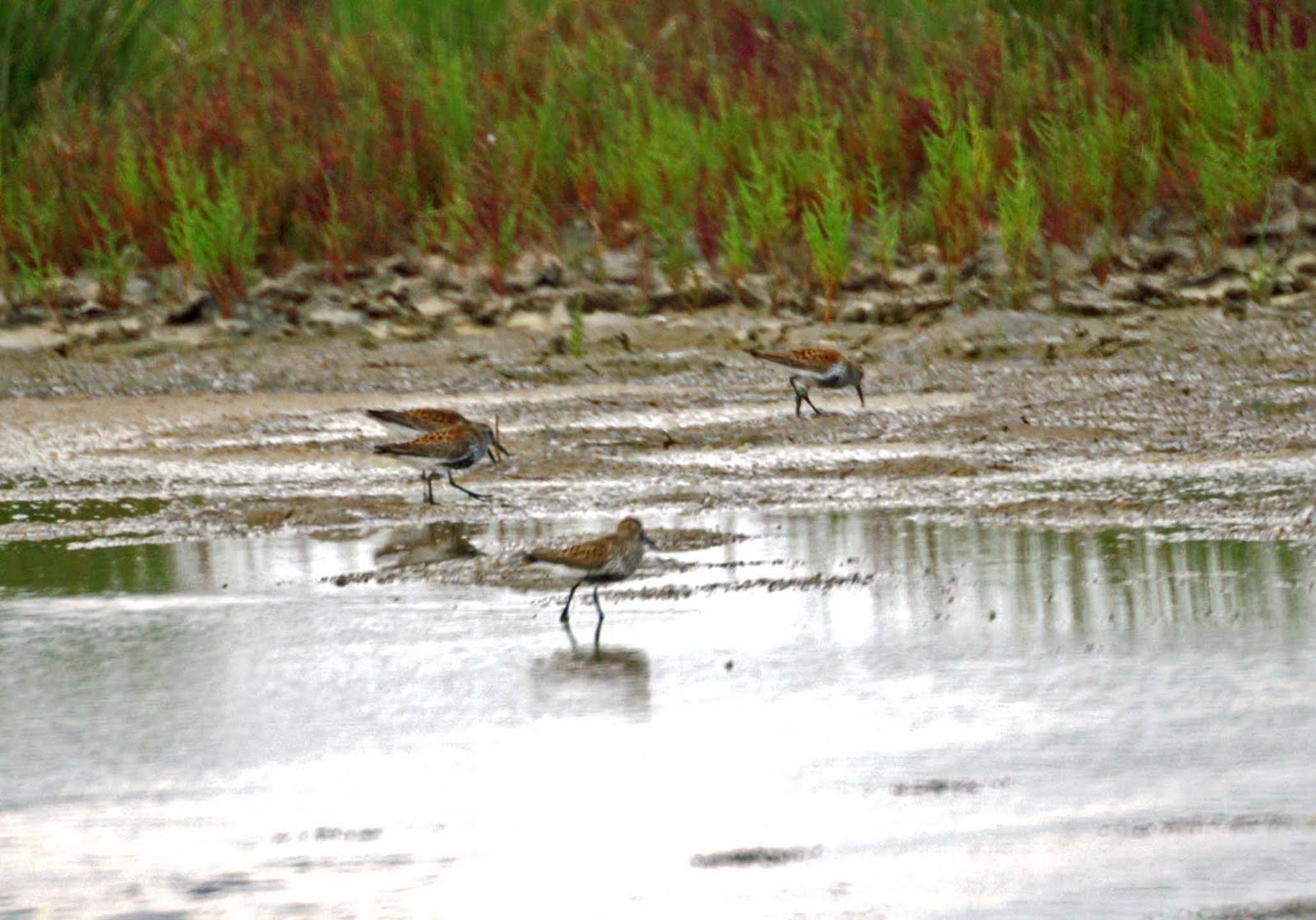
Large numbers of Ringed Plover and Dunlin were foraging in reeded areas where the water was shallow or reduced to damp mud. The blurry white specks in the photo are Ringed Plover; easily 'spooked' they would take off in a cloud, flashing their pale undersides, circle the area in tight formation then return to feed once more. 
Spoonbill - Platalea leucorodia : Spoonbills were present in some numbers, but were not sticking together as a flock as we saw them in this location last year


In some of the flooded areas large numbers of birds of several different species were gathered together to feed. Here there were White Storks, Grey Herons, Little Egret, Grey Plovers, Dunlins, Ringed Plovers & Gulls
Little Egret, standing tall, showing off his long head plumes
There was clearly considerable passage of Ringed Plovers, with several flocks in evidence.  Other waders we saw were Little Ringed Plovers,Kentish Plovers, Grey Plovers – in their beautiful silver and black summer plumage – Dunlin, Redshank, Purple Gallinule, Avocets, and of course Black-winged Stilts, including one sitting on a nest, once again, in the exact location we had seen a nest last year. Near here there was evidence of nesting Pratincoles, which were feeding in the air in some numbers. 
Collared Pratincoles are elegant and graceful in flight 
One or two patches of deeper water had Mallard and Pochard, and there were a few Little Terns and Whiskered Terns flying around also. Smaller birds were less in evidence, although they included Yellow Wagtail, Goldfinch, Crested Lark, Corn Bunting, Reed Warbler, Bee-eater, Swallows and Red-rumped Swallows.
We had quite frequent sights of lovely Yellow Wagtails

Red-rumped Swallows were collecting mud from the bottom of an almost-dry dyke, then flying up to a nearby bridge, beneath which they were clearly building nests

The most common bird of Prey was the Black Kite, with several out hunting, but we saw only one (male) Marsh Harrier. Also present were one or two Kestrels, a Buzzard, and a Short-toed Eagle.


Butterflies we saw included Clouded Yellow, Small White, Painted Lady & Green-striped White.
Clouded Yellow
Painted Lady
The morning passed quickly, and before long we were heading back to El Pinzon for the now traditional Venta meal!

Post-script from Theresa: 


There were a few species of birds that we saw and which John has mentioned in his report, that were too far away for me to photograph adequately, so I'm including a few pictures here that I took on a GONHS outing to Trebujena in May 2007 where we had closer views of Dunlin, Grey Plover & a Little Tern.
Grey Plovers & Dunlins 
Grey Plover (m) - Pluvialis squatarola in summer plumage
Dunlin - Calidris alpina in summer plumage
Little Tern - Sterna albifrons

I also wanted to tag a couple of interesting bits onto the end of the report: 


At the point of leaving the site Jill pointed out an almost surreal sight. In the by now shimmering heat, she had spotted 4 very large birds variously perched on a steel tower-like construction and thought at first that what she took to be Peacocks may have been a mirage. But no, they really were Peacocks!


We were following John to the venta, so unfortunately he and his passengers missed the amazing sighting we had of a Marsh Harrier. Driving down the straight length of road that leads back in the direction of el Palacio, we spotted the raptor as it flew out from behind the tall eucalyptus trees, then it raced low and fast almost alongside us for several hundred metres. It's just as well it was a straight road as Jill was trying to keep the car alongside the bird, which was on her side of the road and give me a clear view of it to try to photograph it while also trying to look at it herself. 
The Marsh Harrier raced alongside us for quite some distance 
Marsh Harrier - Circus aeruginosus


Our final bird tally for the day: (50 species)

Little Grebe, Bittern, Little Bittern, Night Heron, Cattle Egret, Little Egret, Gt. White Egret, Grey Heron, Purple Heron, White Stork, Spoonbill, Glossy Ibis, Mallard, Pochard, Black Kite, Marsh Harrier, Buzzard, Short-toed Eagle, Kestrel, Coot, Purple Gallinule (Swamp Hen), Black-winged Stilt, Avocet, Collared Pratincole, Ringed Plover, Kentish Plover, Grey Plover, Dunlin, Redshank, Little Tern, Whiskered Tern, Wood Pigeon, Collared  Dove, Swift, Bee-eater, Crested Lark, Red-rumped Swallow, Barn Swallow, House Martin, Yellow Wagtail, Blackbird, Fan-tailed Warbler, Cetti's Warbler, Great Reed Warbler, Reed Warbler, Spotless Starling, House Sparrow, Goldfinch, Linnet, Corn Bunting (& Peacock!)